
The Brain: A Dynamic Pattern Machine
Why your memories don't exist in the past
For centuries we've imagined memory as a kind of archive. Experiences happen, they are stored somewhere inside the brain, and when we remember them we simply retrieve the appropriate file.
It is an appealing idea.
It is also almost certainly wrong.
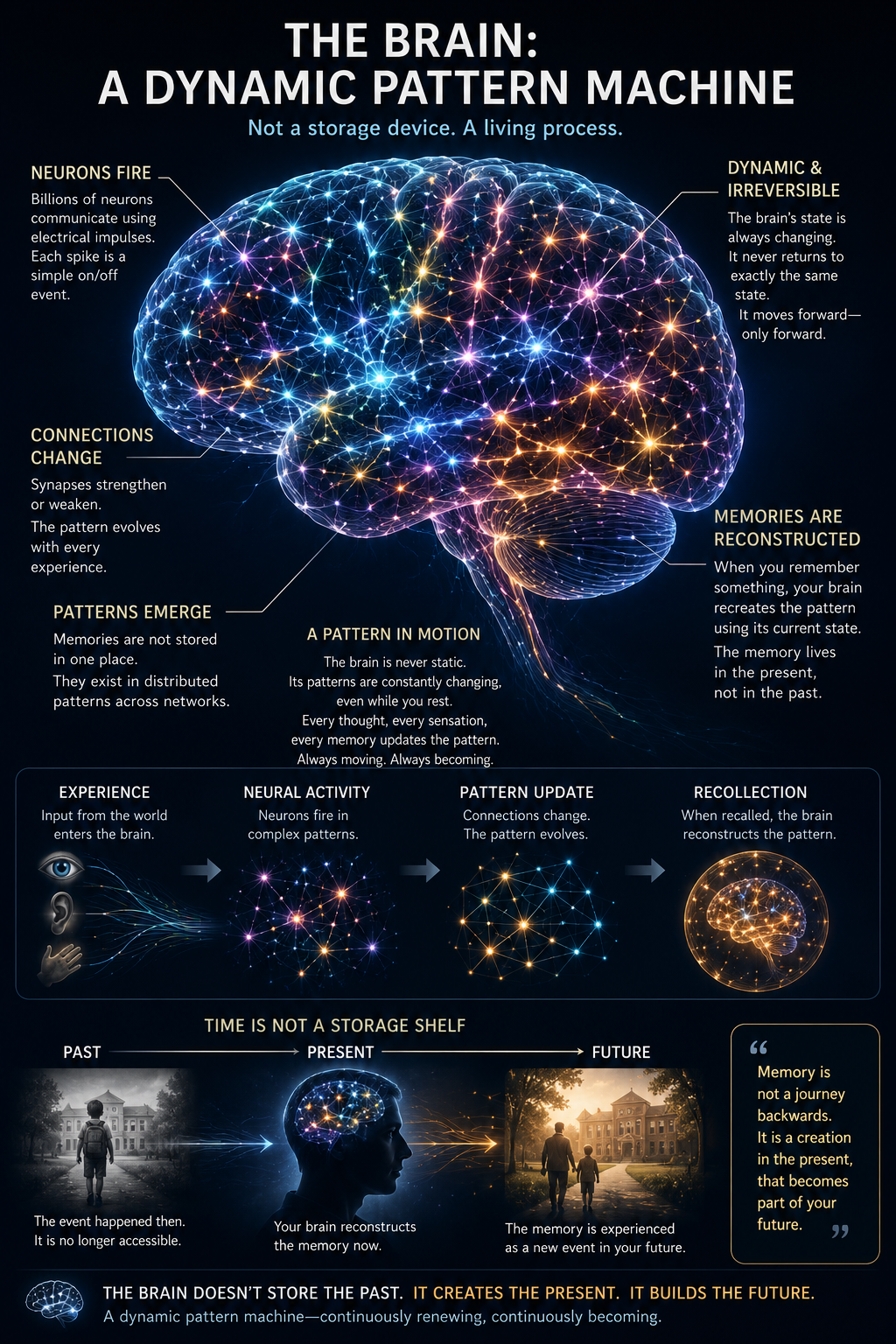
Modern neuroscience paints a very different picture. Memories are not replayed like scenes from a film. They are reconstructed each time they are recalled. Your brain does not retrieve a perfect recording of your first day at school or your wedding day. Instead, it rebuilds those experiences from countless interconnected patterns distributed throughout the brain.
This raises an interesting question.
If memories are reconstructed every time we remember them, where do they actually exist?
The answer may be that they do not exist as static objects at all.
A Living Network
The human brain contains around 86 billion neurons connected by hundreds of trillions of synapses. These neurons communicate through electrical impulses, but the impulses themselves are fleeting, lasting only milliseconds.
If memories existed solely within those electrical signals, they would disappear almost instantly.
Instead, what appears to endure is not the signal itself but the continually evolving pattern of connections and activity across the network.
The brain is not a storage device.
It is a dynamic pattern machine.
Every experience changes the network. Every thought subtly reshapes it. Even recalling a memory alters the pattern that made that memory possible.
The brain is never static.
It is always becoming.
Memory Never Travels Backwards
We often speak as though remembering means returning to the past.
In reality, the opposite may be true.
When you remember your childhood home, you are not revisiting the child who lived there.
You are creating a new experience inside the brain you have today.
Your current knowledge, emotions and experiences all influence how that memory is reconstructed.
The event belongs to the past.
The remembering belongs to the present.
And the reconstructed memory immediately becomes part of your future.
Every act of remembering changes the person doing the remembering.
Memory never travels backwards.
It only moves forwards.
Patterns, Not Objects
Perhaps this reveals something deeper about the nature of information itself.
We tend to think information must exist as an object.
A book sits on a shelf.
A photograph sits in an album.
A computer file sits on a hard drive.
The brain appears to work differently.
The information is not stored in one place.
It exists as relationships between billions of neurons, continually renewed through activity.
Just as a flame exists only while fuel continues to burn, a memory may exist only while its pattern continues to be maintained.
The pattern endures.
The material changes.
A Different Way to Think About Time
This idea resonates with a broader philosophical question.
Perhaps continuity is not the persistence of matter.
Perhaps continuity is the persistence of pattern.
If so, memory becomes another example of a principle found throughout nature: stable identity emerging from continuous change.
The atoms change.
The proteins change.
The electrical activity changes.
Yet the pattern continues.
Not because it is frozen, but because it is constantly renewed.
A Final Thought
Perhaps we have been asking the wrong question all along.
Instead of asking,
"Where are memories stored?"
we should ask,
"How does a living pattern maintain itself while continuously changing?"
The answer may not only deepen our understanding of memory.
It may also change the way we think about time itself.